July 2 – Anacortes to Reid Harbor

Guemes Channel

Heading west in Guemes Channel, we caught the outbound current.

Rosie underway

Rosie curled up on the dashboard…she frequently sleeps while we’re underway.

Mickey underway

Mickey likes to crawl under our foot stool while we’re underway…a nice secure place for him.
Double Island anchorage

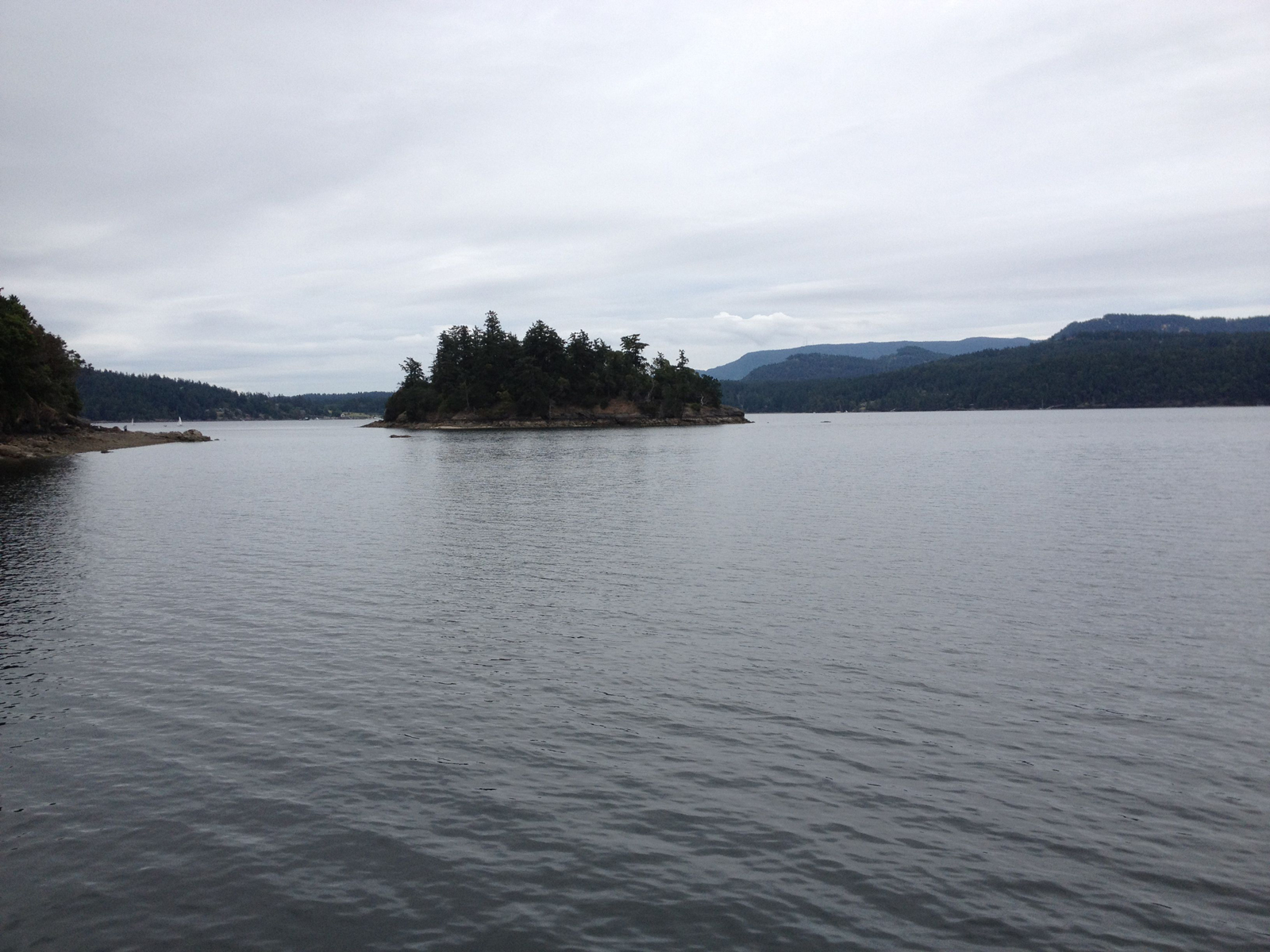
Looking into West Sound from our anchorage behind Double Island, where we stopped for a couple of hours to wait for the Speiden Channel current to change.

Mickey relaxing at Double Island

After we got settled at Double Island, Mickey came out from under the stool and showed us one of his best relaxation poses.

Navionics on iPad next to Raymarine Chart Plotter

The navigation display on the left is on the iPad using the Navionics app “Marine & Lakes U.S. and Canada,” and on the right as it looks on our Raymarine Chart Plotter.
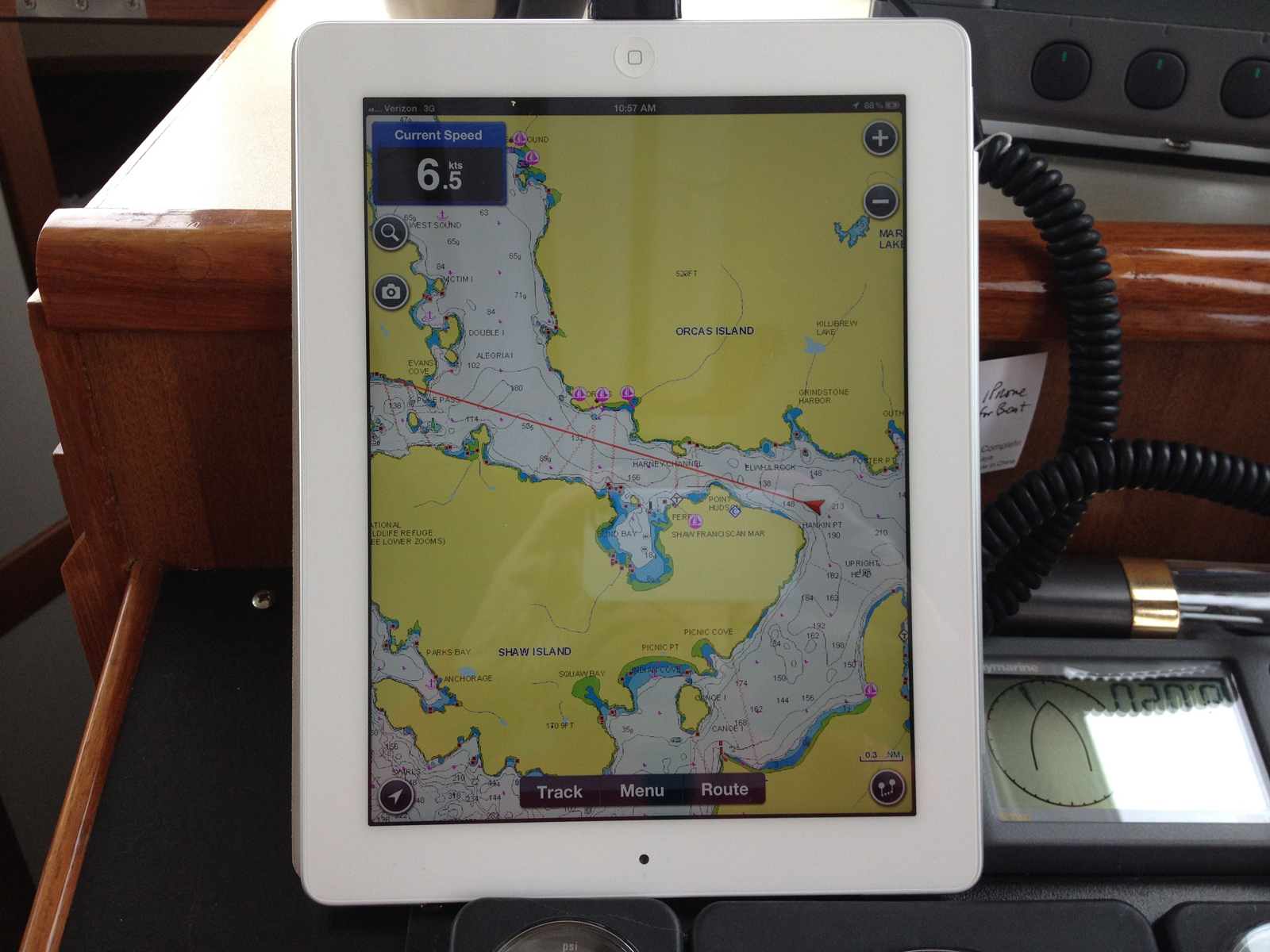
Navigation display on the iPad

A closer look at the iPad navigation display. Notice the red line that continuously updates while we are underway to show where we are headed. What a great tool!

Whale watching boat

We passed this whale watching boat as we crossed San Juan Channel on our way to Reid Harbor.

Container ship in Haro Strait

As we approached Reid Harbor, we spotted this container ship in Haro Strait, headed for Boundary Pass.

Entrance to Reid Harbor

Approaching the entrance to Reid Harbor on Stuart Island, one of our favorite anchorages in the San Juans.

Reid Harbor anchorage

In Reid Harbor, Stuart Island, looking toward the head of the anchorage.

First, a note. We are now back in Anacortes after a one-week cruise from July 2nd to the 8th…but we did not have access to the Internet while we were out, so publishing the posts from our cruise has been delayed. This is the first post from our cruise…more to come soon!

The weather conditions in Anacortes looked good this morning…grey and overcast, but no strong wind and no rain. This was a good morning for us to head out for our first cruise of 2012.

We caught the outbound current in Guemes Channel, and crossed Rosario Strait near the slack. We found lots of boat traffic in Harney Channel this morning, including several ferries. One of the ferries came up behind us as we motored west in the narrowing channel by Shaw Island…we got caught between the oncoming ferry and a large power boat with an enormous wake next to us paralleling our course, so ended up turning toward the beach and slowing almost to a stop, then going in a circle so that we could cross behind all of them. Harney Channel can get really crowded in July and August!

This was our first opportunity to use the Navionics iPad app “Marine & Lakes U.S. and Canada” for navigation. What a neat tool! It has an outstanding display, fast seamless operation, and runs from the iPad’s GPS without the need of a cell connection. The GPS does use a lot of battery, so we discovered it was best to have it hooked up to a power source. We set up the iPad alongside our 10-year-old Raymarine chart plotter and found there was no comparison…the iPad was much better! In addition to following our course, the app also provides a great tool for looking up the tide and current information for any given location.

First time out every year we get to see if things work. Most things were okay, except… The AIS wasn’t working, but that turned out to be a loose wire. And the knot meter didn’t work, and we thought that might be due to something being stuck in the paddle wheel…but no matter how much maneuvering we did, the knot meter still didn’t work. We’ll need to do more investigating to find the problem.

We turned into West Sound and found the anchorage behind Double Island empty so decided to anchor there for a few hours to wait for the current in Speiden Channel to change. We were heading on to Reid Harbor, and wanted to avoid the strong adverse current along Speiden Island. Waiting until later in the day would give the current time to moderate and reverse.

We left Double Island around 1500 and found much less boat traffic than we experienced this morning. And more favorable current! However, the clouds thickened and we had light rain most of the way. Even though we waited for more favorable current in Speiden Channel, we still encountered a strong tide race with lots of whirlpools near Limestone Point.

We found lots of boats in Reid Harbor, but there was still plenty of room to anchor. It turned into a cold, rainy night. But the heavier rain held off until later in the night, so we were able to barbecue salmon for dinner, along with steamed green beans. Felt nice to be out on the anchor again.

More WiFi Fun

Jim drilling holes to reinstall WiFi bridge.

Jim pulled out the two bottom drawers under our helm seat to install the WiFi equipment. Here he is drilling a hole to bring up the exterior antenna cable to the space under the drawers.

Jim inserts the new airport into its new location.

Jim inserting the new Apple Airport base station into its new location under the drawers in the cabinet below our helm seat.

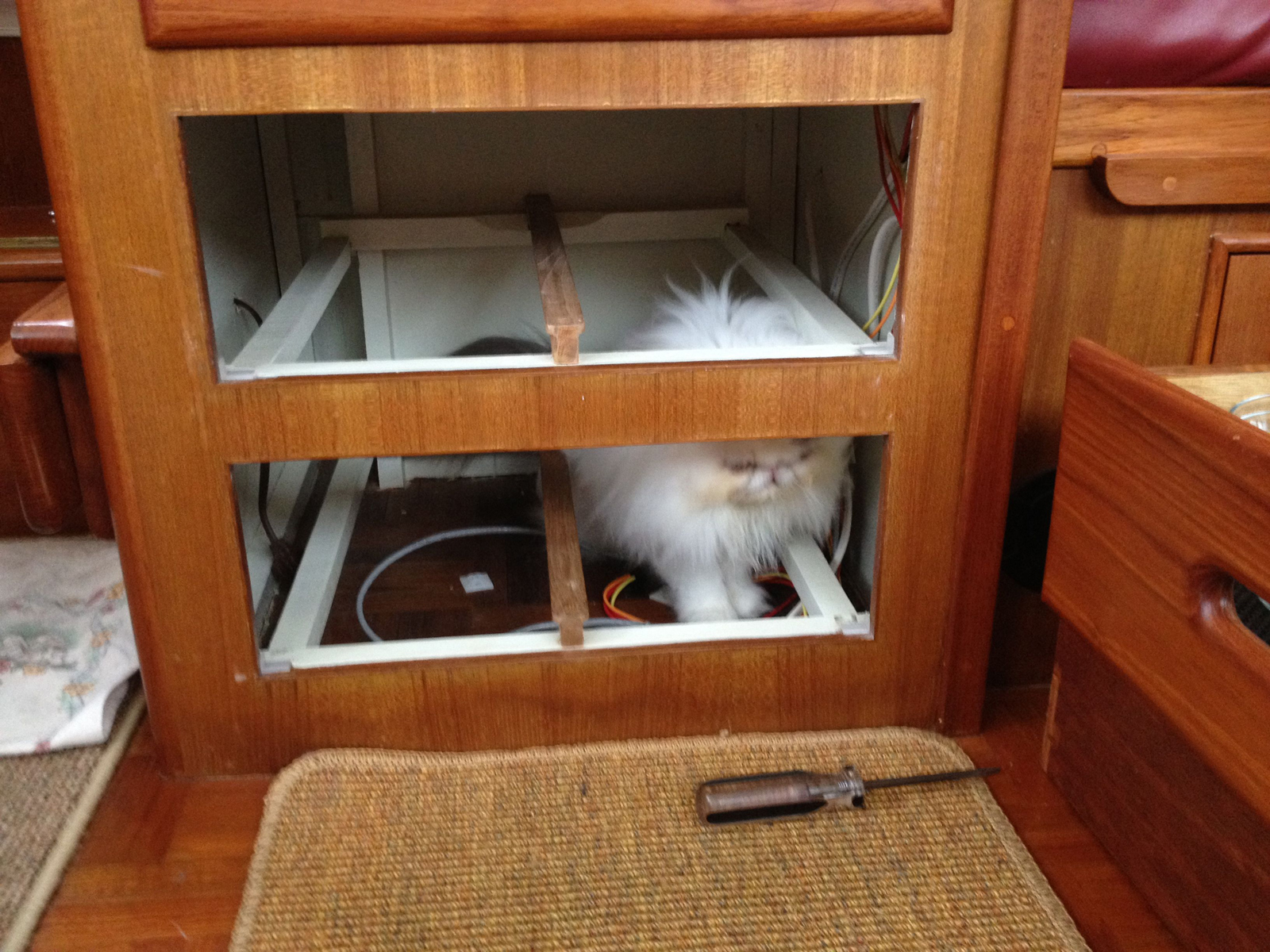
Mickey explores the open space where the drawers have been removed.

Of course, as soon as the drawers were removed and there was open space, both kitties had to check out the space. Here Mickey is inside, looking around. Rosie followed shortly thereafter.

WiFi equipment under the drawers.

The bridge and new Airport base station (router) fit nicely in the space under the bottom drawer.

Argh! We lost our Internet connection this week…the new WiFi bridge is still good (see May 28 post), but the 6-year-old Apple Airport base station that we use as a router seems to have become buggy. So we went to Best Buy and bought a new one. Yesterday Jim worked on re-wiring the on-boat WiFi system to hook it up to the new Airport. The new Airport device is smaller than the old one, so now there is room to install both the Airport and the bridge in the area under the drawers in the cabinet below the helm seat.

After rerouting the cable connections to the exterior antenna and hooking up everything, our system seemed to be back and working as it should. However, this morning it was down again, so looks like we need to do more trouble shooting. In the meantime, we are able to connect our laptop directly to the bridge, so we are able to reach the Internet from at least one device.

Meanwhile…we have a free week between eye doctor exams/surgeries in connection with Jim’s cataracts (his next exam is July 10), so we are getting ready to leave the dock (yea!!) to spend a few days in the San Juans. We thought we’d leave this morning, but the wind has come up a bit here in Anacortes and there is a gale watch posted for the East Entrance of the Strait of Juan de Fuca for later this afternoon, so we have decided to wait for a better weather window before departing…Rosario Strait can be a bit uncomfortable when the SE wind blows against the current.

Superwinch Inaugural

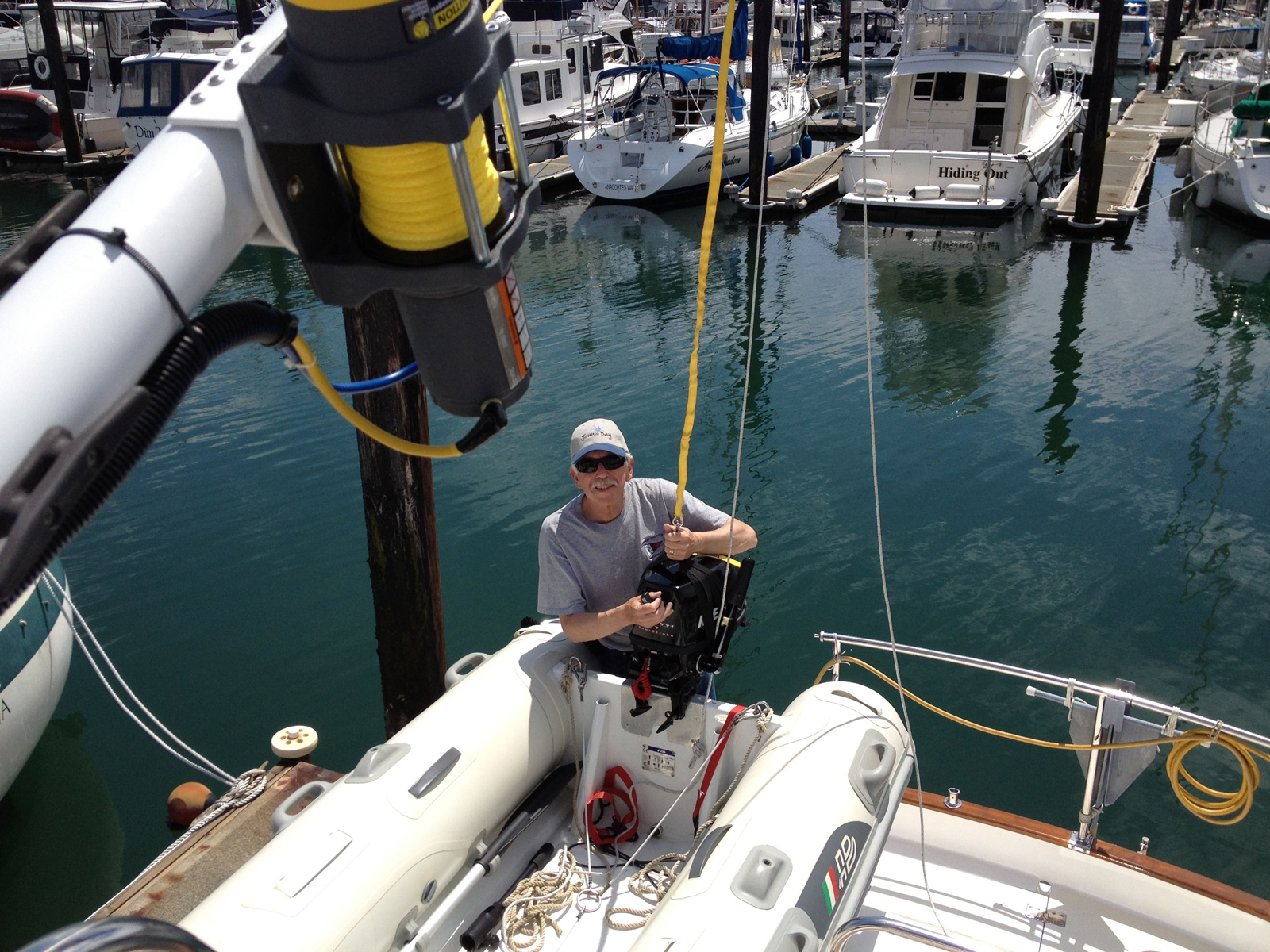
Lifting the outboard with the Superwinch

Jim guided the outboard as we used the Superwinch to lift it from the dock so he could attach it to the dinghy on deck. My job was to press the hoisting button on the winch remote.

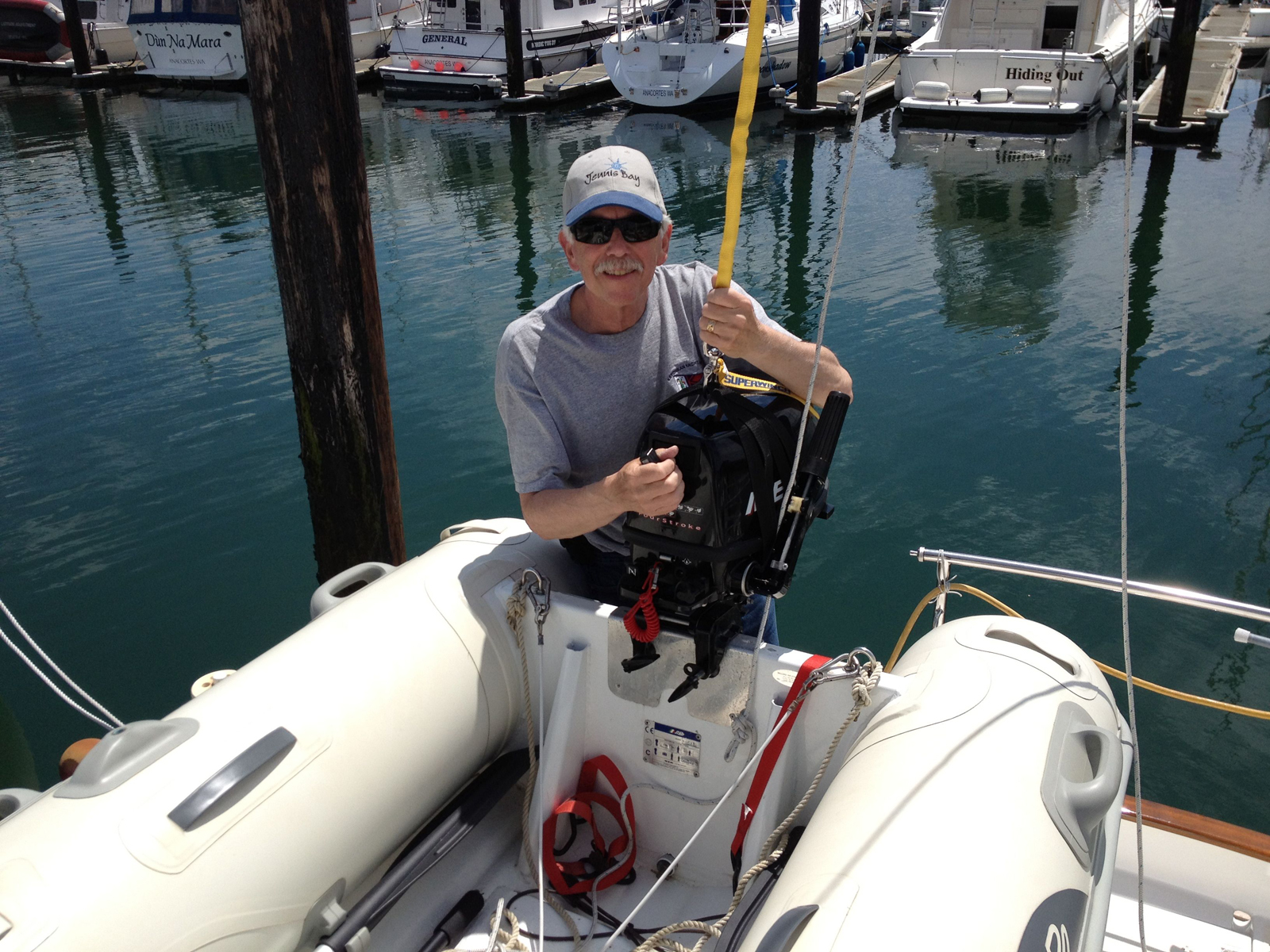
Lifting the outboard with the winch - closeup view

A close up view of Jim attaching the outboard to the dinghy. The other end of the yellow hoisting line is connected to the drum of the Superwinch.

Today we got our chance to actually use our new Superwinch!

At high tide this morning, Jim brought the dinghy outboard motor down from our storage unit. We store the outboard in our storage unit every winter, then get it out and put it on the dinghy when we’re ready to use it. Since the dinghy is stored on the aft boat deck, we have to lift the outboard from the dock to the deck.

In the past, we’ve lifted the outboard from the dock slowly by cranking the manual winch, but today we let the Superwinch do the job. It quickly got the outboard up and onto the deck where Jim could attach it to the dinghy. Neat! We’re very pleased with how our new system performs.

Dinghy Hoisting Line

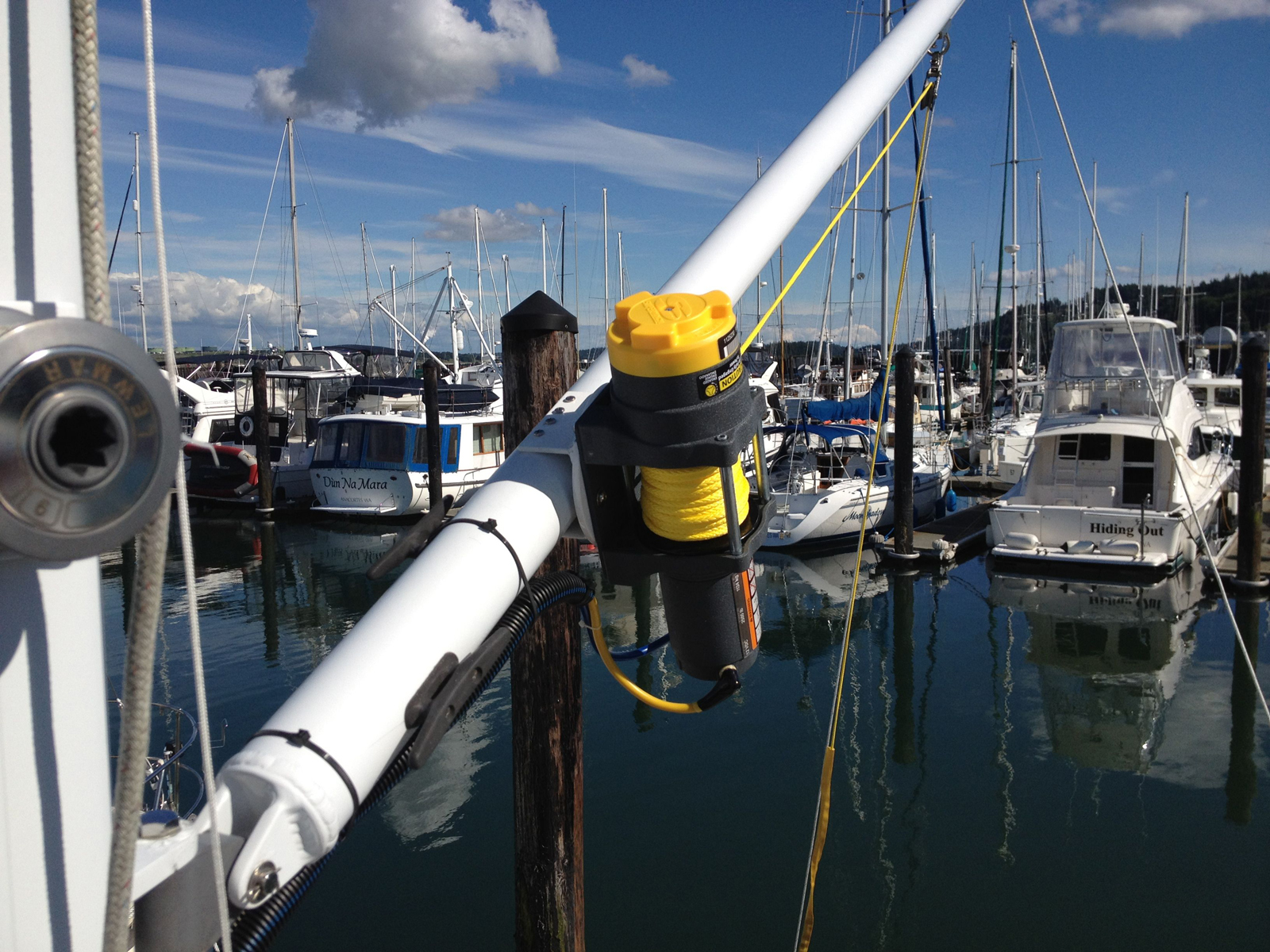
Superwinch with hoisting line

The Superwinch mounted on our boom, with the dinghy hoisting line wound on the winch drum. The yellow line looks like polypropylene, but actually it is AmSteel.

Superwinch with line, close-up view.

A close-up view of the AmSteel hoisting line wound around the Superwinch drum.

Our electric dinghy hoisting winch system is getting closer to being complete. Jim wound the hoisting line onto the winch drum today. The yellow line we’re using came with the Superwinch. It looks like polypropylene, but actually is a product called AmSteel. It is 3/16 inches in diameter with a breaking strength of 5400 pounds…more than strong enough for our 275 pound dinghy and outboard motor!

AmSteel is a product of Sampson Rope. We found the following description of it in the Fisheries Supply catalog: “A high-performance 12-strand single braid of 100% Dyneema SK-75 fiber, AmSteel yields the maximum in strength-to-weight ratio, very low stretch, and is stronger than the same sized wire rope constructions — yet it floats. It’s the highest strength single braid Samson makes. Samthane coating enhances an already high abrasion and cut resistance. Adding a cover is recommended for areas handled by winch or rope clutches.”

This line sounds pretty good to us. It’s also lightweight and easy on the hands.

Cataract Be Gone

MASH 4077th

It’s that kind of summer!

Today Jim had the first of his two cataract surgeries. Surgery was about 45 minutes from start to finish…driving time between Anacortes and our opthamologist in Seattle was about 4 hours (round trip). All went well, and we will have a couple more trips to Seattle in the next week for post-surgery exams to be sure.

Tonight Jim is wearing a clear, hard plastic eye patch to protect his eye for the next 24 hours…kinda a pirate look… His second eye cataract surgery will be in 4 weeks.

Winch Wiring Finished!

Wiring the system on/off switch

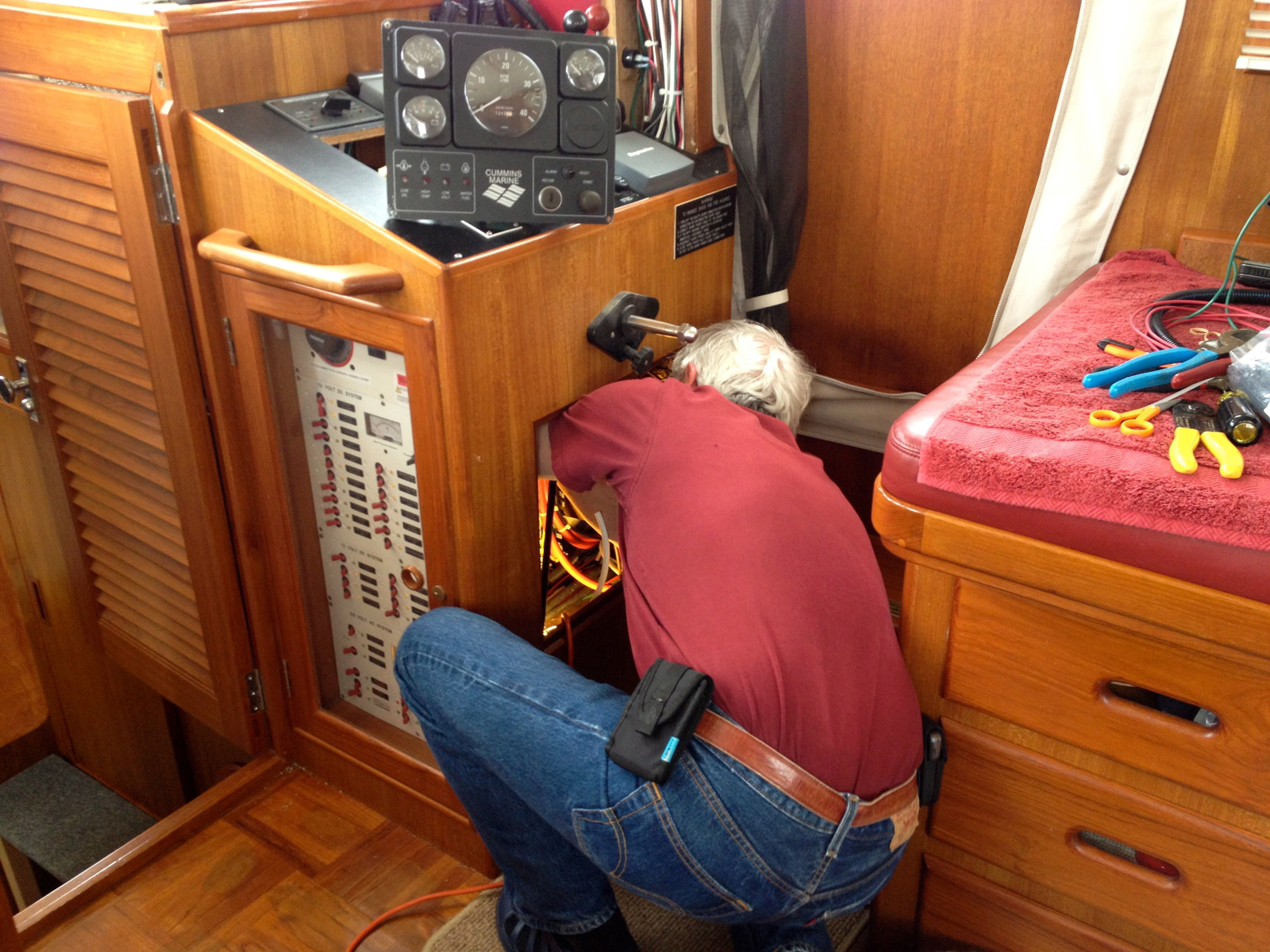
Jim working on the wiring in the electrical panel for the winch system on/off switch.

System on/off switch

The winch system on/off switch is a push-pull switch, and we mounted it behind our steering wheel, just under the electrical safety placard.

Winch battery charger

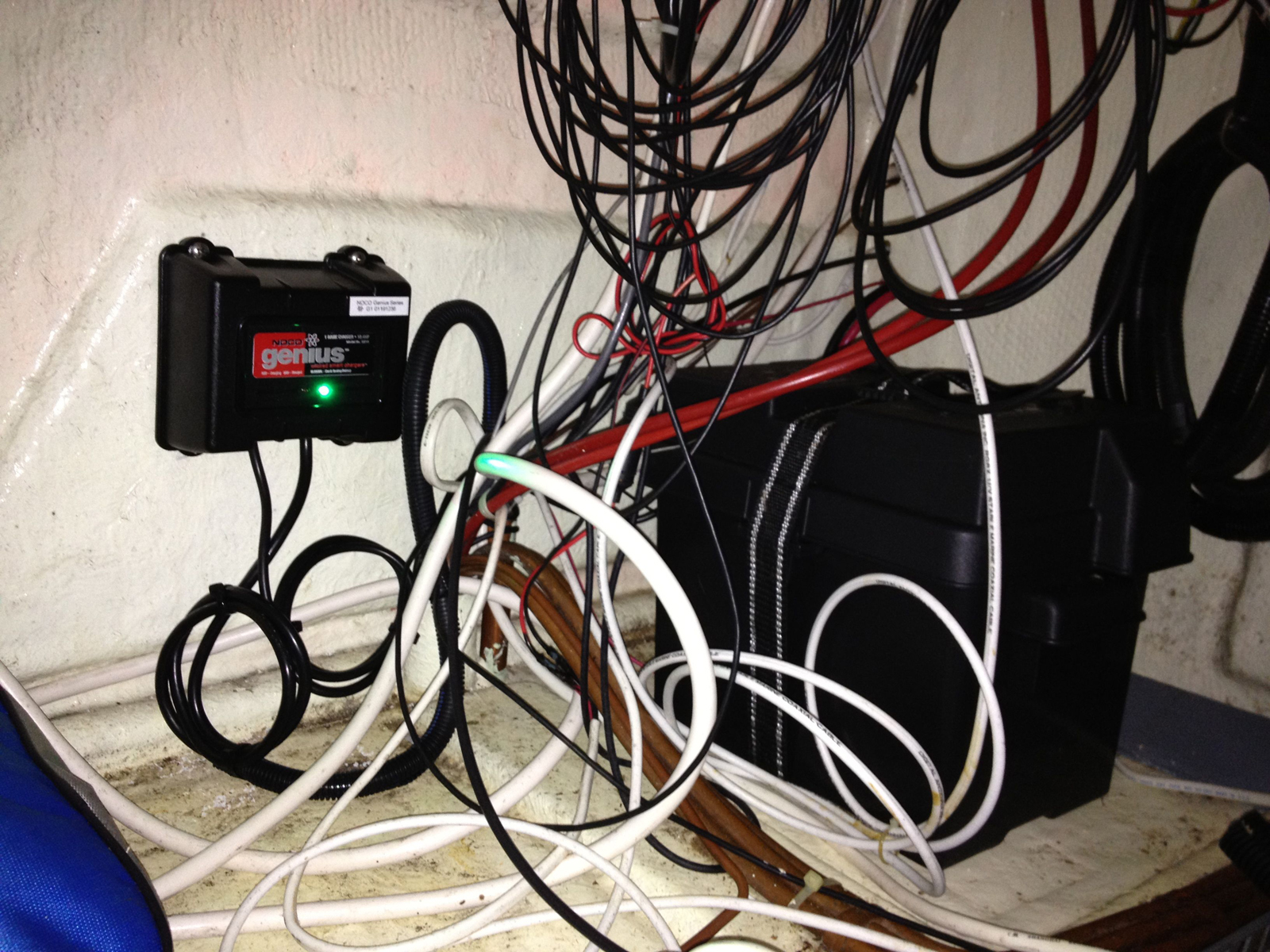
We mounted the battery charger for the winch battery in our flybridge storage locker, near the winch battery. The green light means the battery is charged.

We were trying to get the wiring for the electric winch finished before Jim’s eye surgery on June 21st, and we did!

We found a place for the system on/off switch behind our steering wheel, where we can easily reach it to turn power on and off to the winch. This switch provides power to the solenoid coil.

Next we ran the cables from the winch motor to connect them to the battery. Then we mounted the battery charger on the inside wall of the flybridge storage locker, near the winch battery, and connected the charger to the battery.

Then we were ready to power up everything to do a system test. It all works!

Next we will need to wind the hoisting line onto the winch drum and actually hook it up. And then we’ll be able to test the whole operation. Let’s hope it’ll lift the dinghy…